


EXPLORING TEXTILES OF THE CHIAPAS HIGHLANDS
Updated: Jun 29

Juana Lopez's back-strap loom - March 2026
Photo by J.Bjarnason
WEAVING THE MAYA COSMOS
EXPLORING TEXTILES OF CHIAPAS
During our last tour to Chiapas, we were honoured to spend time with Maya textile expert Estaquia Ruiz, who is the curator of the Centro de Textiles del Mundo Maya (Centre of Textiles of the Maya World). The museum itself is a favourite of visitors due to their extensive collection of vintage and new huipiles (traditional Maya blouses), showcasing the evolution of clothing from various villages throughout several decades. Doña Ruiz hails from the small mountain village of Oventic, which is in the centre of the Zapatista heartland. Serious textile collectors are known to venture into this region, seeking authentic weavers to learn about their techniques and styles directly from them. What made our experience with Doña Ruiz so special, was her network of local contacts, variety of textiles she introduced us to, along with loom techniques and the explanations about the significance behind the animal motifs and cosmic patterns. It was also comforting to visit this region with someone local who could seek permission from the weavers before we visited their homes, as this is a show of respect in indigenous communities, and something we value deeply.

Brilliant threads are all the rage today - March 2026
Photo by J.Bjarnason
The scenic roads that climb into the Chiapas Highlands are a colourful experience of brightly painted homes with plastered facades, wrought iron balconies and terracotta-tile rooftops that glow warmer in the afternoon sun. The narrow streets are a mix of cobblestone, gravel and cement and every length of road features endless woodpiles for cooking fuel. Such a blend of Spanish Colonial, Baroque, Moorish and Indigenous influences set against the pine-forest backdrop frames each scene like a photograph one would love to paint, including rural scenes of farmers tending their fields among an abundance of sheep. Having been to Chiapas a few times before, I found this journey exceptionally mesmerizing for so many reasons.
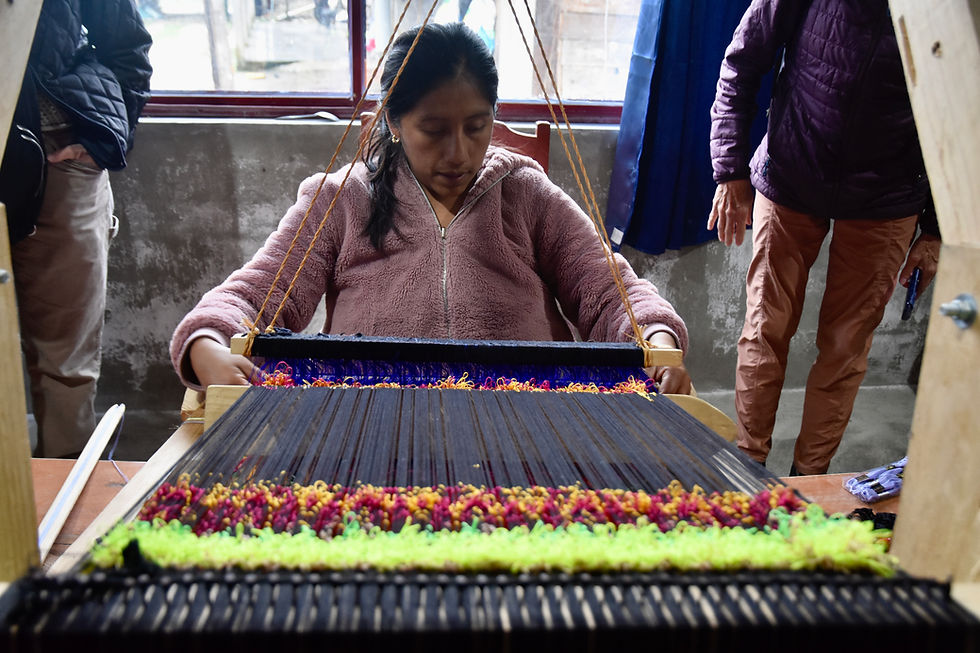
Martina Ruiz works the peddle loom- March 2026
Photo by J.Bjarnason
LADY XOC'S FAMOUS HUIPIL
ELEVATED BEYOND THE PHYSICAL
One of the reasons I was inspired to connect with Doña Ruiz was because I knew her village & municipality is where weavers continue to replicate traditional, museum quality huipiles, as were once worn by ancient Maya women, including the famous Lady Xoc, Queen Consort of the ancient Maya city of Yaxchilan. Many archaeologists believe Lady Xoc's husband, King Itzamnaaj Bʼalam III, who was a legendary ruler of Yaxchilan between 681-742, ascended to the throne because of her lineage, thus possibly elevating his status. She became his primary wife, though she was older than him and could not bear children. Lord Izamnaaj B'alam III had at least 3 other wives who wore similar huipiles to Lady Xoc's famous ceremonial robe, but they were of lesser design quality, indicating lower status. It's incredible that the designs seen on the stone lintels of Lady Xoc from 1284 years ago predated her birth by at least 1000 years, according to the archaeological records. These garments were more than a fashion statement or for mere symbolism, they transported the wearer into a different realm, from the physical to the spiritual cosmos and were specifically used for important ceremonies and blood rites.
For those unfamiliar with this design, the diamond pattern shown in the images below represent the universe. The central diamonds are connected to one diamond above, and one diamond below. These do not represent north or south, but instead east and west, due to the movement of the sun each day. As a sun-worshiping culture, these directions are prominent in Maya political organization, architectural design, city planning, and even in their ceremonial robes. This same diamond pattern is slightly altered for the night sky, depicting Venus surrounded by stars...

Lady Xoc kneels before King Itzamnaaj Bʼalam III in her cosmic ceremonial robe
Lintel 24 from Yaxchilan now housed in the British Museum
AN IMPORTANT DISTINCTION
BACK-STRAP VS PEDDLE LOOM
Fabrics woven on back-strap looms, like hand embroidery, were hard to mimic for many years, as there were several tells between what was made slowly, and what was created on a manuel machine. Today's peddle looms are more advanced, making this a little more technical to assess.
When we arrived at Doña Ruiz's family home in Oventic, the women downstairs were busy crafting by hand, but upstairs was an amazing loom in motion between the fingers and foot peddles of Martina Ruiz, who is Doña Ruiz's sister. She's one of the only weavers in the village who has mastered this loom, which shortens the work to approximately 1 month from 3 or 4 months. We were interested to find out how one could tell the difference between what took three or four months to weave, and what took only one...

Back-strap woven table runner - March 2026
Photo by J. Bjarnason
There are a few things to observe about these table-runners. They are both folded in half to show the front and back, but the main elements to look for are on the front. Though the purple piece has long lines stitched across the back that seem obvious, the more important design features to understand are found in the three parallel lines that form the large outer diamond shapes on the front. You will notice the golden garment has 3 very smooth lines, but the middle line on the purple garment looks slightly like twisted rope. This piece also has tiny little diamond squares in the corners of the pieces, which in combination with the twisted rope look, tell you it was made on a peddle loom.

Peddle-loom woven table runner - March 2026
Photo by J. Bjarnason
To make matters more confusing, when a piece is woven on a traditional back-strap loom, but features multiple colours, they are not as neat on the backside of the garment as the golden piece is. They are not stitched into the fabric consistently like the purple garment, but have long stretches of loose threads wherever they are not stitched into the front. The biggest reason why it's helpful to identify these from the front is because sometimes pieces are lined, making it impossible to look at the backside.


This back-strap piece looks different from the golden piece - March 2026
Photo by J. Bjarnason
In Lady Xoc's time, life must have had an incredibly different pace from our modern, technological world. It's certainly understandable why Maya weavers have turned to machines to craft their exquisite textiles. Even still, as we observed Martina working that loom, it was really difficult to understand how it worked and the learning curve must be tremendous, including how to load the strings onto it so it creates this pattern. She explained that even though it's much faster than a back strap loom, she only weaves about 4 inches of fabric every 10 hours.

Zapatista embroidery - March 2026
Photo by J. Bjarnason
MAGUEY WOVEN BAGS
HANDWOVEN FIBRE
Downstairs, the women were creating a number of different textiles, including hand embroidered "resistance" Zapatista paraphernalia, back-strap loomed cloth and traditional bags that are woven out of maguey rope. Called morrales or ixtle, these maguey bags are a pre-Hispanic technique requiring about 2 months to weave.
To make a morrale or ixtle bag, the maguey, which is a type of cactus, must be processed, dried and smoked. The spinning is done manually using hands to roll the fibre against ones' leg. Woven on homemade frames, these bags are durable and practical, finished with a leather strap.


Maguey Bags - March 2026
Photo by J.Bjarnason
A WONDERFUL LUNCH
TRADITIONAL MAYA CUISINE
Doña Ruiz's family served us a hearty and traditional Maya lunch while we were in Oventic, and it was interesting to see how differently the tortillas were made, as they are much larger than just about everywhere else I've had the fortunate to visit in Mexico! The stew was made from a special salted beef that was cured, and is something generally reserved for special occasions.
As with most traditional kitchens in Mexico, our lunch was cooked over a fire and the tortillas were grilled on the camal. The number of tortillas women make each day for their household can total around 200, depending on how many family members live there!


Homemade Tortillas & Beef Stew - March 2026
Photo by J.Bjarnason
BLACK WOOL AS STATUS
THE FAMOUS CHAMULAN SKIRT
Our next stop was at the Lopez home in San Juan Chamula, where the most iconic skirts of Chiapas are made from thick, black wool. These skirts require a lot of patience, as the weavers must first sheer, clean, card and spin the wool before they can begin to weave it. These skirts also now include shiny warp threads that get hidden in the fabric, though they are visible from the inside.
What a wonderful time we had at yet another home of weavers, where they were eager to dress us up in their skirts so we could feel how heavy they are. Chamulan women wear these skirts daily and they are a symbol of status. When the wool is spun, they brush it out to render long, full strands, and the longer and fuller the strands are, the more the skirt is worth.
After we learned about the weaving, we were invited across the street to learn about how these skirts are dyed. Of course, they are already a rich dark colour, due to the wool being natural, but once they are woven, the skirts are submerged in a dye that consists of mud and iron-rich minerals with the famous anil plant, which is used for indigo tones. Mixed into the mineral dyes for these skirts gives them a blue-black sheen and evens out the natural tones of the wool. To set the dyes, these skirts must be submerged for up to 3 days. It was interesting to see that these weavers are still using natural dyes, as so many families switched to synthetic dyes.
When we return for our weaving workshop in November, Doña Ruiz is organizing a very special day with a Maya elder who is famous for her knowledge of natural pigments and dye techniques. We are truly looking forward to meeting her and having such a rare opportunity to learn rom her.

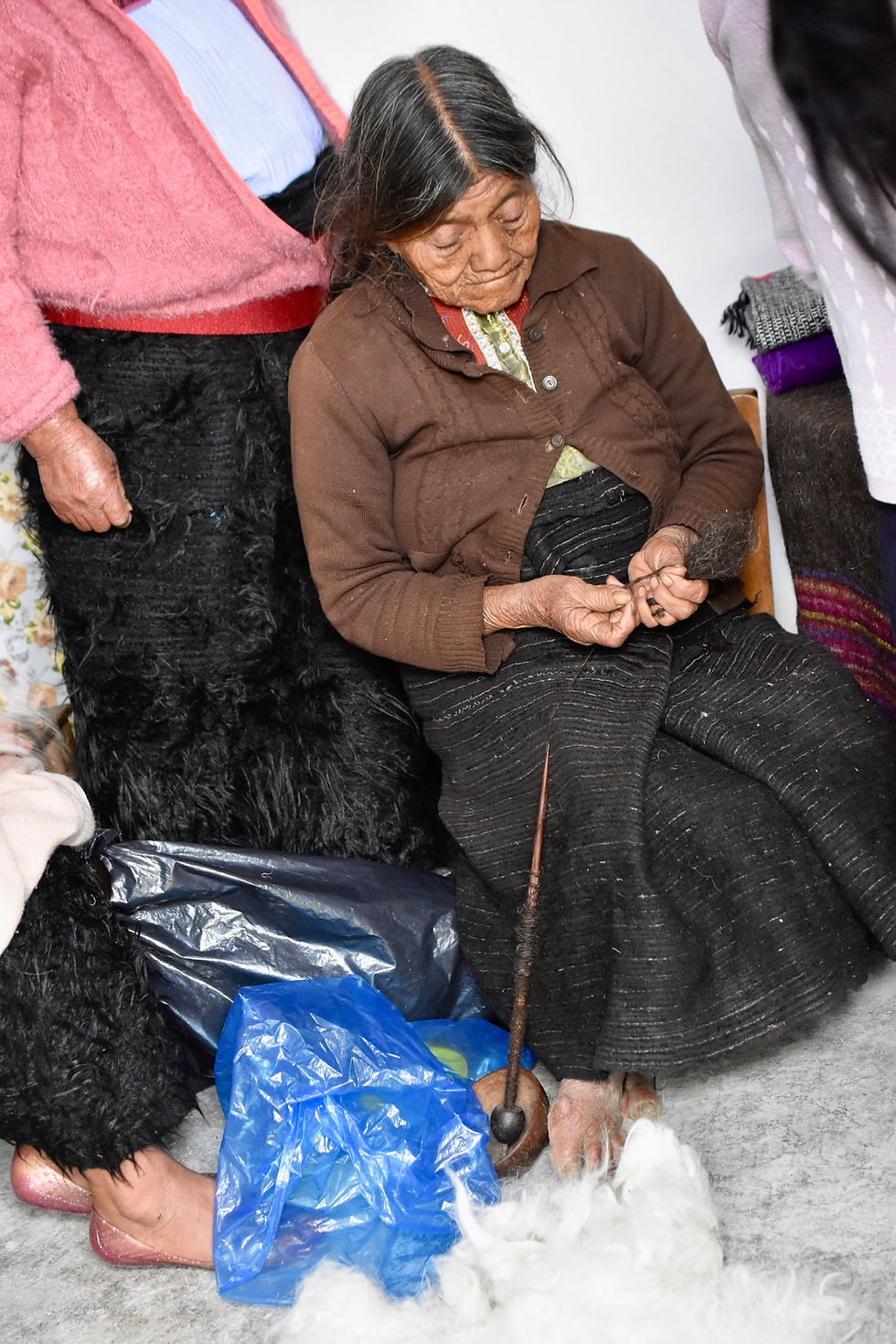

Top Photo: Our guest Sydney gets dressed up in a very high status skirt & cape.
Middle Photo: Doña Micaela Lopez Hernandez spins with a drop spindle
Bottom L-R: Juana Angela, Juana, Rosie, Veronica, Maria, Gloria & Micaela
What was interesting about our stop here, was that Doña Ruiz had asked if we wanted to take photographs, and I was adamant that we would only take them if we had permission. She had mentioned that we may need to pay for photographs, and this began a discussion about whether or not they would be comfortable with that. I didn't want to offend anyone. She wrote to me that attitudes have changed in some places as it has been recognized that photographs can really help to elevate this work due to the possibility to promote it and attract new customers. As it turned out, upon arrival, they signalled that they were quite happy for us to take some photographs, and they did not want to charge us.
San Juan Chamula is quite famous for their disdain for photography, including very strict protocols inside their sacred church. If you do visit, please be very careful about this and do not take photos in the plaza without asking for permission first. Inside the church, it is strictly prohibited and can result in a hefty fine, jail time and destruction of your memory card or even your camera.
We are excited to be offering a textile tour this November for collectors and creatives. Please check the links below for all of our upcoming tours, and let us know if any of them interest you!
Thanks for reading,
Warm Wishes,
Jennifer


Comments